

Leave Your Message
Choosing Enameled Aluminum Wire starts with the job it must perform, not the lowest price per kilogram. Aluminum is much lighter than copper, but its lower electrical conductivity often requires a larger conductor cross-section to meet the same resistance target. That difference can affect winding dimensions, heat rise, slot fill, and connection design. The International Aluminium Institute’s 2022 analysis projected global aluminum demand could increase about 40% by 2030 from 2020 levels, reflecting aluminum’s expanding role across industries. That market signal is useful context, not a wire-selection rule. Details matter.
For a motor, transformer, or compact coil, compare conductor size, enamel type and thermal class, breakdown-voltage needs, flexibility, and the applicable IEC 60317 or NEMA MW specification. Check the datasheet for resistance, dimensions, and temperature limits; similar labels can conceal meaningful differences. A tougher coating may resist abrasion during winding, yet reduce usable space. Terminations deserve equal attention, because aluminum oxide can complicate reliable joints unless the process and connectors suit aluminum. USGS Mineral Commodity Summaries 2025 provides authoritative supply context, but availability alone cannot establish electrical suitability. Ask suppliers for test records and sample wire, then validate it on your winding equipment. The right choice balances performance, heat, manufacturability, and lifetime cost—not one headline specification.
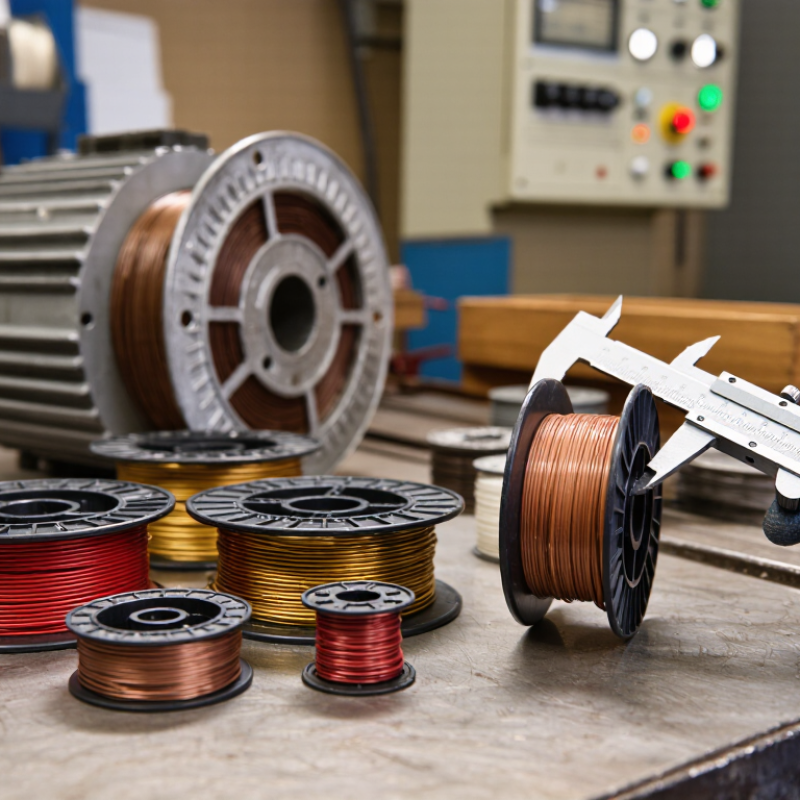
Enameled aluminum wire is an aluminum conductor covered by a thin insulating coating. The metal carries electrical current; the enamel keeps neighboring turns from making unwanted contact. Thin, but essential. Compared with copper, aluminum is lighter and has lower electrical conductivity, so wire dimensions and connection design matter. The right choice depends on the equipment, operating temperature, and winding space.
Manufacturing begins with aluminum rod, which is drawn through progressively smaller dies to reach the required diameter. Heat treatment can restore flexibility after drawing. The wire is then cleaned and coated with liquid insulating enamel. It passes through a heated oven, where the coating cures, and this process may be repeated to build the required insulation thickness. That sounds simple. It isn’t. Line speed, coating consistency, and oven temperature all affect the result.
Quality checks may include measuring conductor size and coating thickness, and testing insulation continuity and adhesion. A tiny bare spot can matter when wire is wound tightly around a bobbin. Exact tests vary by product specification, so buyers should compare those requirements with the conditions their equipment will face. A process description can look neat on paper; real production still needs careful control, and no single coating suits every winding.
| Selection Dimension | What It Means | Typical Data or Manufacturing Detail | How to Choose |
|---|---|---|---|
| Conductor material | Enameled aluminum wire is an aluminum conductor covered with an electrically insulating enamel film. | Aluminum has a density of about 2.70 g/cm³ and electrical conductivity of approximately 61% IACS at 20°C. | Consider it when low weight is important. Because aluminum is less conductive than copper by volume, a larger conductor cross-section may be needed for comparable resistance. |
| Conductor diameter | The diameter of the bare aluminum conductor, before the enamel coating is applied. | Magnet-wire products are available in a broad range of diameters; exact size ranges and tolerances depend on the applicable standard and product specification. | Choose the diameter based on current, allowable temperature rise, winding space, and the design’s electrical requirements. Confirm whether a quoted diameter is bare-wire or finished-wire diameter. |
| Electrical resistance | Resistance affects winding losses and voltage drop. It depends on conductor material, cross-section, length, and temperature. | Aluminum resistivity is approximately 2.82 × 10⁻⁸ Ω·m at 20°C. Resistance increases as conductor temperature rises. | Check resistance per unit length at the specified reference temperature, and account for operating temperature when estimating losses. |
| Enamel thermal class | The thermal class indicates the insulation system’s temperature rating under defined test conditions; it is not automatically the maximum continuous temperature of the complete device. | Common insulation-system classes include 155°C, 180°C, 200°C, and 220°C, as defined in IEC 60085. | Select a class compatible with the winding’s expected thermal conditions, other insulation materials, and applicable equipment requirements. |
| Enamel build and finished diameter | The enamel layer provides turn-to-turn electrical insulation and increases the overall wire diameter. | Coating thickness and finished diameter vary with conductor size, insulation grade, and whether the coating is specified as a thin, normal, or heavier build. | Match the build to electrical insulation needs and available winding space. Use the relevant wire standard and supplier drawing for dimensional limits. |
| Mechanical and winding requirements | The wire must tolerate winding, bending, and handling without unacceptable conductor damage or enamel cracking. | Performance depends on conductor temper, diameter, enamel system, winding radius, and process conditions. | Verify that the wire suits the winding method and bend radius. For production, assess it using the relevant mechanical and insulation tests. |
| Electrical insulation requirements | Insulation performance includes properties such as dielectric strength, continuity, and resistance to abrasion. | Test results depend on conductor size, coating build, enamel system, and the specified test method; a single value is not universal. | Request test requirements and acceptance limits that match the application and governing standard rather than relying on a generic voltage figure. |
| Aluminum termination and joining | Aluminum forms a surface oxide layer, which can make reliable electrical connections more demanding than ordinary copper connections. | Connection performance depends on joint design, surface preparation, compatible terminals or joining methods, and environmental exposure. | Use a connection method designed for aluminum and follow its preparation and installation instructions. Validate joint resistance and durability in the intended environment. |
| Typical manufacturing sequence | The conductor is prepared and insulated through a controlled wire-making process. | Common steps include aluminum rod preparation, drawing to size, annealing as required, cleaning, repeated enamel application and curing, followed by inspection and winding onto reels. | Ask for process controls and inspection criteria relevant to conductor dimensions, coating continuity, electrical performance, and the final application. |
| Quality checks | Testing helps confirm that the finished wire meets its dimensional, electrical, and mechanical specification. | Checks may include conductor and finished diameter, coating appearance, electrical continuity, dielectric testing, and mechanical tests specified for the product. | Specify the governing standard, sampling plan, and required documentation before purchase. Test methods and limits should correspond to the wire size and insulation grade. |